
The “Illusion of Explanatory Depth” is a concept that’s time has arrived. Although our Information Age has placed the history of knowledge in the palm of our hands, it has also convinced many among us that we comprehend complicated issues at a deeper level than we actually do. Typical examples of this phenomenon involve our familiarity with everyday objects and our sense that we understand how they work. Ask the average person if they know how a lightbulb or a microwave function, and many will answer yes. But when pressed to provide a detailed explanation, people quickly realize that they have only a cursory appreciation for how these objects operate.
We consistently fail to grasp just how complicated the world around us actually is. Leonard Rozenblilt and Frank Keil coined the phrase illusion of explanatory depth to describe how, “Most people feel they understand the world with far greater detail, coherence, and depth than they really do.”
What should interest us most about this phenomenon is not that we assume we generally know how cell phones work when we really don’t. It’s that we are a nation in the midst of a cultural identity crisis where the issues of division are far too complicated for nearly anyone to casually apprehend in a nuanced way. Healthcare, police reform, foreign trade, climate change, and Covid-19 are all hyper-complex topics that defy easy explanations or solutions. Yet so many of us are eager to plant our flag on the cultural battleground of an issue like wearing a mask in public, while simultaneously being incapable of contemplating virology at any level above the superficial.
The illusion of explanatory depth is further compounded by other cognitive biases like the Dunning-Kruger effect. David Dunning and Justin Kruger proposed this cognitive bias in 1999 to explain how an individual’s lack of knowledge or skill often leads to an illusory sense of superiority on a given topic. Alternatively, individuals with higher levels of knowledge or skill tend to overestimate those same traits in others. In describing their theory, they quote Charles Darwin, who once pointed out that, “Ignorance more frequently begets confidence than does knowledge.”
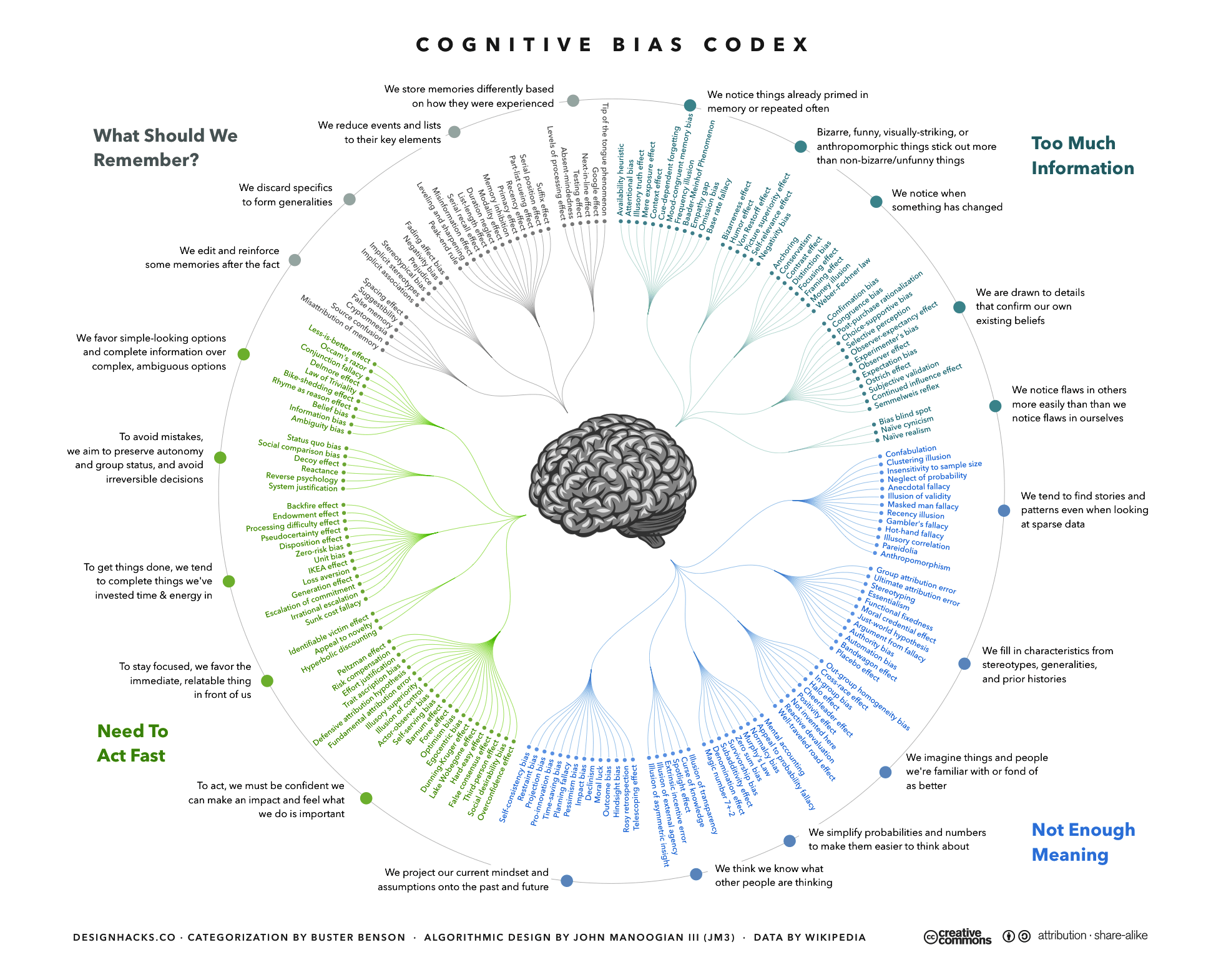
In a world of ever increasing complexity, it is incumbent upon us to grapple directly with our tendency to reduce the cultural, political, and spiritual challenges of humanity down to ill-conceived caricatures. As individuals, we must take it upon ourselves to pause and reflect on the opinions we hold, which may have much more to do with tribal allegiances than substantive insights.
This is easier said than done. Each of us is an assemblage of cognitive biases wading through an existence we, to a large extent, will never fully comprehend. As Jonathan Haidt noted in his essential book, The Righteous Mind, homo sapiens evolved in social groups where cognitive traits more associated with being a lawyer than a scientist were evolutionarily advantageous. In other words, we’re more invested in winning arguments than in casting accurate judgments upon the world and those in it.
Nonetheless, we have the option to respond with humility rather than despair in the face of this predicament. It can be cathartic to every so often say, “I don’t know.”
Ironically, the human propensity for generating fictional narratives about how the world works may in fact be the defining advantage of our species. In his book Sapiens, Yuval Noah-Harari contends that, “Myths and fictions accustomed people, nearly from the moment of birth, to think in certain ways, to behave in accordance with certain standards, to want certain things, and to observe certain rules. They thereby created artificial instincts that enabled millions of strangers to cooperate effectively. This network of artificial instincts is called ‘culture’.”
A problem with many of the narratives guiding our modern culture is that they tend to be incomplete, misleading recipes for human conflict rather than human flourishing. There is a difference between discrete facts and the stories we create to knit those discrete facts together. As Nassim Taleb points out in The Black Swan, “The narrative fallacy addresses our limited ability to look at sequences of facts without weaving an explanation into them, or, equivalently, forcing a logical link, an arrow of relationship upon them. Explanations bind facts together. They make them all the more easily remembered; they help them make more sense. Where this propensity can go wrong is when it increases our impression of understanding.”
In other words, care must be taken not to confuse the map for the territory.
While stories may be the water we swim in, they can also be the storms that drown us. The stories we tell ourselves about the world are powerful tools, and like all tools, can be used to create or destroy. The decision to wear or not wear a mask is anchored to some narrative about the veracity of stories that detail the danger and communicability of Covid-19. If you’ve chosen not to wear a mask, surely you have a story about why you and your loved ones are not simply deciding to compromise your own health, rather, it is likely that you believe the fears of others to be overblown and unwarranted. Likewise, the decision to wear a mask comes packaged with a story about the dangers of the virus and your responsibility to others in your community, as well as to your own personal health.
You may quibble with my decision to continue using the word “story” in place of a more appropriate alternative like “hypothesis” or “theory.” But it is the rare soul that has their nose buried in scientific journals wrestling with medical literature that rises to the level of hypothesis or theory. Further, most of us are not spending our time reading 5,000-plus word essays in serious but accessible publications that are reporting on the science of the current pandemic or listening to 3-hour podcasts where virologists explain their understanding of this virus. Most of us are not contemplating whether the precautionary principle applies to our current circumstances or seeking out the voice of experts in sorting out statistical data on the virus.
Instead, mask wearers and mask swearers alike are getting the bulk of their information from cable news and talk radio. Fox, CNN, and NPR are primarily peddling stories biased by politics and compromised by the brevity that their advertisers and our short attention spans demand. We should not confuse infotainment shoveled from those and other platforms for substance or understanding. Nor should we assume more reliable, rigorous sources of information come to us free of bias. They don’t, which is why the role of the individual is to cultivate the critical thinking and reading skills necessary to navigate our information saturated modern environment.
So, what to do?
As the psychologist Jordan Peterson puts it, clean up your room. Recognize the inner lawyer for what he is: a motivated reasoner. Take stock of the juxtaposition between how little we do know and how much there is to know. Our public discourse is in disarray, in part, because of shallow stories that serve to divide us on facile grounds. That our institutions of government, media, and academia fail us so regularly makes our task that much more difficult and our personal responsibilities in the face of this decay that much more imperative.
Transcending the mire of our modern age begins with the individual. Study the categories of cognitive biases and identify a personal example of when you have fallen victim to each one of them. Make a list of all the issues you have a strong opinion about, and then seek out the best arguments against your position. Steel man the arguments of those who disagree with you. Engage in conversation with the goal of understanding rather than winning. Notice the pleasure of having your intuitions pushed around a bit. And embrace deep learning as a personal imperative for making tomorrow better than today.
Some intuition pokes:
 Holoscene